Stone size and layer depth are different measurements.
Geometry = area × depth · Order volume = geometry × loose-volume multiplier × (1 + waste ÷ 100)
Identify the actual river-rock product
River rock is a commercial description rather than one universal grading. Braen Supply lists several river-rock sizes, including sizes that overlap its pea-gravel offering. Keep the product name, size range and a representative sample together. Color and smoothness alone do not specify how much visible coverage a particular layer will provide.
Measure only the stone-covered footprint
For a straight border, use the inside length and width of the area receiving stone. Exclude paving, fixed structures and unfilled planting pockets. Break an irregular outline into non-overlapping measured sections and save each estimate. If you use a bounding rectangle as a conservative approximation, label it as such rather than presenting it as an exact area.
Check a sample at the proposed depth
The dimension of one stone is not the same as the depth of the whole layer. Check your supplier’s coverage guidance for the product size and intended arrangement. A thin decorative scatter, a continuous cover and a deeper loose layer are different design choices. The example depth here is simply an input that makes the arithmetic checkable.
Worked border example
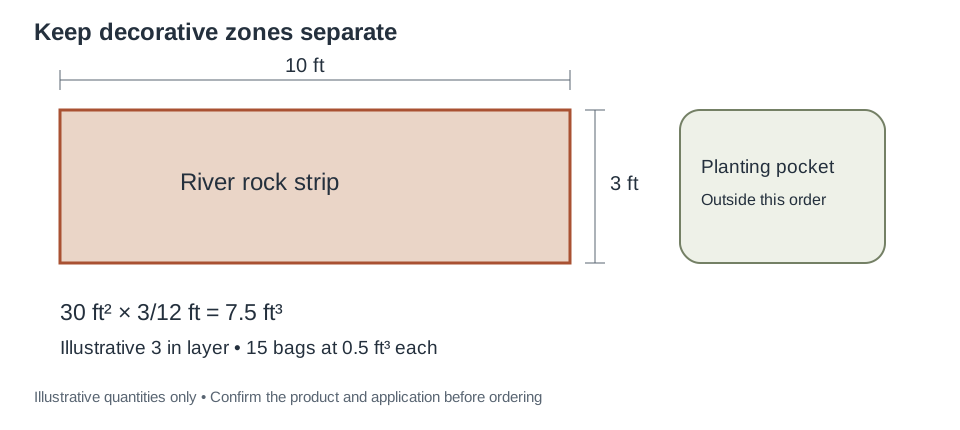
A 10 ft by 3 ft strip at an illustrative 3 in depth needs 10 × 3 × 3 ÷ 12 = 7.5 ft³, or 0.277778 yd³. With 0.5 ft³ bags and no allowance, the order is 15 whole bags. If the selected layer were 2 in instead, it would need 5 ft³, or ten bags of that same size.
Two zones require two order lines
Suppose one design includes a 6 ft by 4 ft small-pebble area at 2 in and a separate 6 ft by 1 ft larger-rock strip at 3 in. The quantities are 4 ft³ and 1.5 ft³ respectively. Their combined volume is 5.5 ft³, but ordering that volume of only one product would not complete the design. Save and label each product separately.
Metric bags and the purchased amount
A 3 m by 0.8 m border at a selected 50 mm needs 0.12 m³, or 120 litres. At 25 litres per bag, round up to five bags, which provide 125 litres. If your chosen ordering buffer is 10%, the requirement becomes 132 litres and six bags. That buffer is illustrative, not a standard allowance for river rock.
Convert to weight only with a supplied bulk density
River-rock mass depends on the actual product and its loose arrangement. Ask for density that includes the voids between the delivered stones, rather than the density of solid rock. Enter the supplied kg/m³ or lb/ft³ to estimate order weight, and verify whether a quoted ton means a US short ton or a metric tonne. There is no hidden default density.
Keep decorative cover separate from water management
A stone-covered area does not by itself establish drainage capacity or a suitable outlet. If the feature will convey runoff or surround equipment, follow the relevant site design or manufacturer specification. This calculator estimates a user-selected material layer; it does not size a drain, design a channel or establish a load-bearing installation.
Plan access and maintenance before delivery
Keep irrigation valves and service covers reachable. Decide how leaves or soil will be removed without losing the smaller stones from the delivered range. Mark separate stockpile areas for different products, compare the delivery ticket with the chosen sample and retain the printed quantity record for future top-ups.
Before you place an order
Check dimensions, bag yield and the price basis. Whole bags round up; bulk orders may have minimum quantities or delivery charges that this calculator does not include. All adjustments are your inputs. Read our method, unit definitions and limits.
Material references
Reviewed 8 October 2026. Product examples explain terminology; no universal density or depth is inferred.
Useful questions
Can I calculate individual boulders with this tool?
No. The calculation models a bulk layer over an area. Individual feature stones need their own supplier dimensions, weight and handling plan.
Is a cubic yard of river rock always the same weight?
No. A cubic yard is volume. The bulk mass depends on the product, voids and delivered condition; enter the supplier’s applicable density for a weight estimate.
Can I calculate a circular bed?
Yes. Choose circle and enter diameter or radius consistently. For a central unfilled circle, measure the remaining area as suitable sections rather than counting the central space.