 Rob
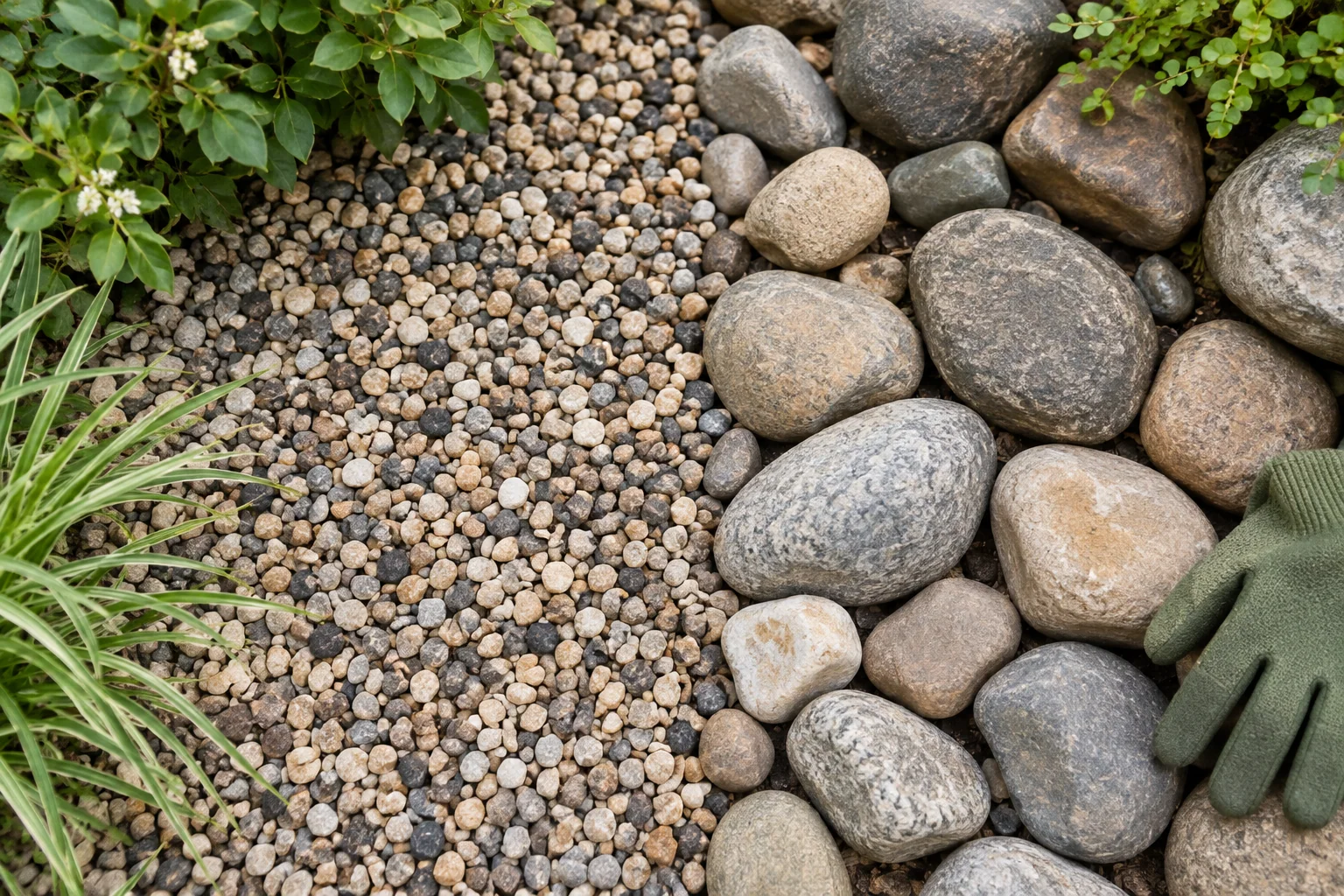
Pea gravel usually brings to mind small rounded pebbles, while river rock often suggests larger decorative stones. In practice, the names overlap. Compare the actual size range and sample, then decide whether the area is intended for walking, furniture, planting access or mainly visual cover.
| Source / product | Listed variants | How to use the example |
|---|---|---|
| Braen Supply material guide | 3/8-inch pea gravel; 3/8-, 3/4- and 1-inch river rock | Confirm the actual selected product |
| Southwest Boulder Chamois Beige Pea Gravel | 3/8-inch and 3/4-inch variants | Check the variant and current local availability |
| Zone | Key question | Practical check |
|---|---|---|
| Walking route | Can intended users move comfortably and reliably? | Trial the complete proposed surface |
| Decorative border | Can plants and irrigation still be maintained? | Reach and cleanup test |
| Furniture area | Do feet sink, tilt or displace stones? | Use the actual chair and table |
| Water feature cover | Does the stone suit the specified equipment? | Check size, load and service access requirements |
Smooth stone is not automatically a comfortable or stable walking surface. The particle size, amount of loose material, support below and intended activity all matter. A larger rounded rock can look attractive in a border while being awkward on a frequently used route. A smaller pebble can be easier to spread but more readily tracked beyond its edge.
Check the labels rather than assuming two fixed categories
Braen Supply's material-guide page lists 3/8-inch pea gravel alongside 3/8-inch, 3/4-inch and 1-inch river-rock products. That is a useful real-world example of overlapping size terminology. “River rock” is not a single large-stone grade that can be compared with every pea-gravel product.
Southwest Boulder's Chamois Beige Pea Gravel sheet lists 3/8-inch and 3/4-inch sizes under the same product name. Check the selected variant and available local stock. A name remembered from a previous order may not tell the supplier which size you intend to buy this time.
Keep the name, product code and size together throughout the project. If a quote shortens the description to “pebbles,” ask for clarification before delivery. This becomes especially important when small surface material and larger accent stones are being purchased for the same garden.
Use dimensions to understand the visual difference
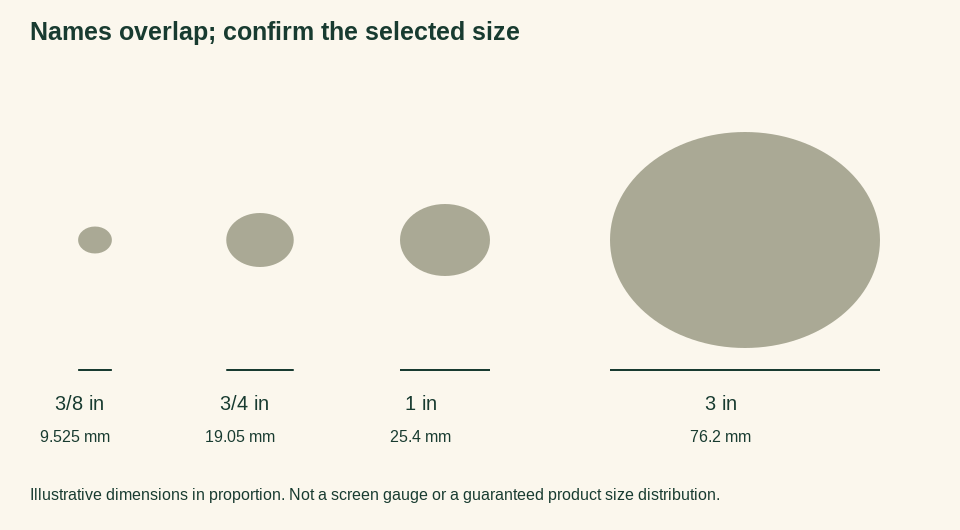
A 3/8-inch dimension is 9.525 millimetres; 3/4 inch is 19.05 millimetres; 1 inch is 25.4 millimetres. A 1–3-inch decorative range spans 25.4–76.2 millimetres as a dimensional translation. These conversions explain scale, not the permitted grading of a particular product.
The original pebble dimension illustration compares example sizes in proportion. It is not a true-size screen gauge. Printed dimensions and a ruler are more reliable than apparent size in an online product photograph, especially when photographs use different crops or lack a scale reference.
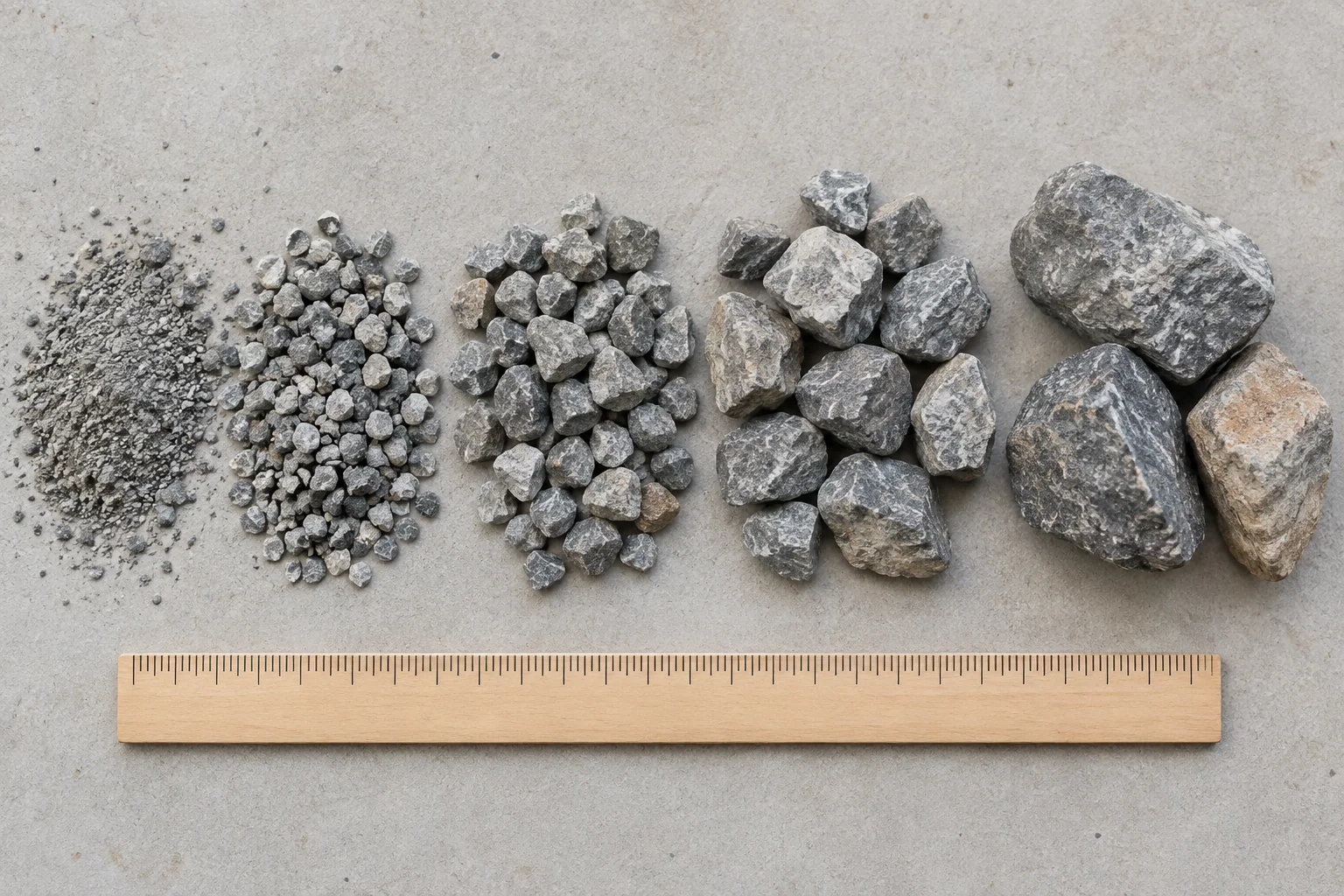
Ask to see a representative sample of the offered range. Notice how much variation it contains, including flatter pieces and smaller stones. A single selected pebble shows color and texture; a wider sample gives a better impression of the finished surface's visual pattern.
Separate surface smoothness from walking comfort
Run a hand over a sample to assess its texture, but also test the proposed surface underfoot. Rounded edges describe an individual stone. Comfort depends on how the stones support the foot, move beneath it and interact with the footwear normally used in that part of the garden.
Try walking, turning and stopping on a representative panel. Include the people who will use the route, rather than having one person judge for everyone. A surface that feels acceptable in firm-soled work shoes may feel different in sandals, and a decorative border may never need to support routine walking at all.
Do not choose a main access route from a general marketing claim that a stone is comfortable. Where firm access is essential, compare an appropriate complete pathway system. A loose sample trial can inform a personal preference, but it cannot certify a route against formal accessibility requirements.
Match the material to a clearly defined zone
A garden can use different materials in different zones. A firm route beside a decorative river-rock strip may meet the needs better than asking one loose material to perform every task. Draw the boundary and transition details before calculating quantities so the zones remain distinct.
Keep frequently serviced items reachable. Irrigation valves, lights and water-feature access panels should not disappear beneath an arrangement that takes substantial effort to dismantle. A photograph of the finished garden can look simple while concealing a difficult routine maintenance job.
Trial furniture and small wheels
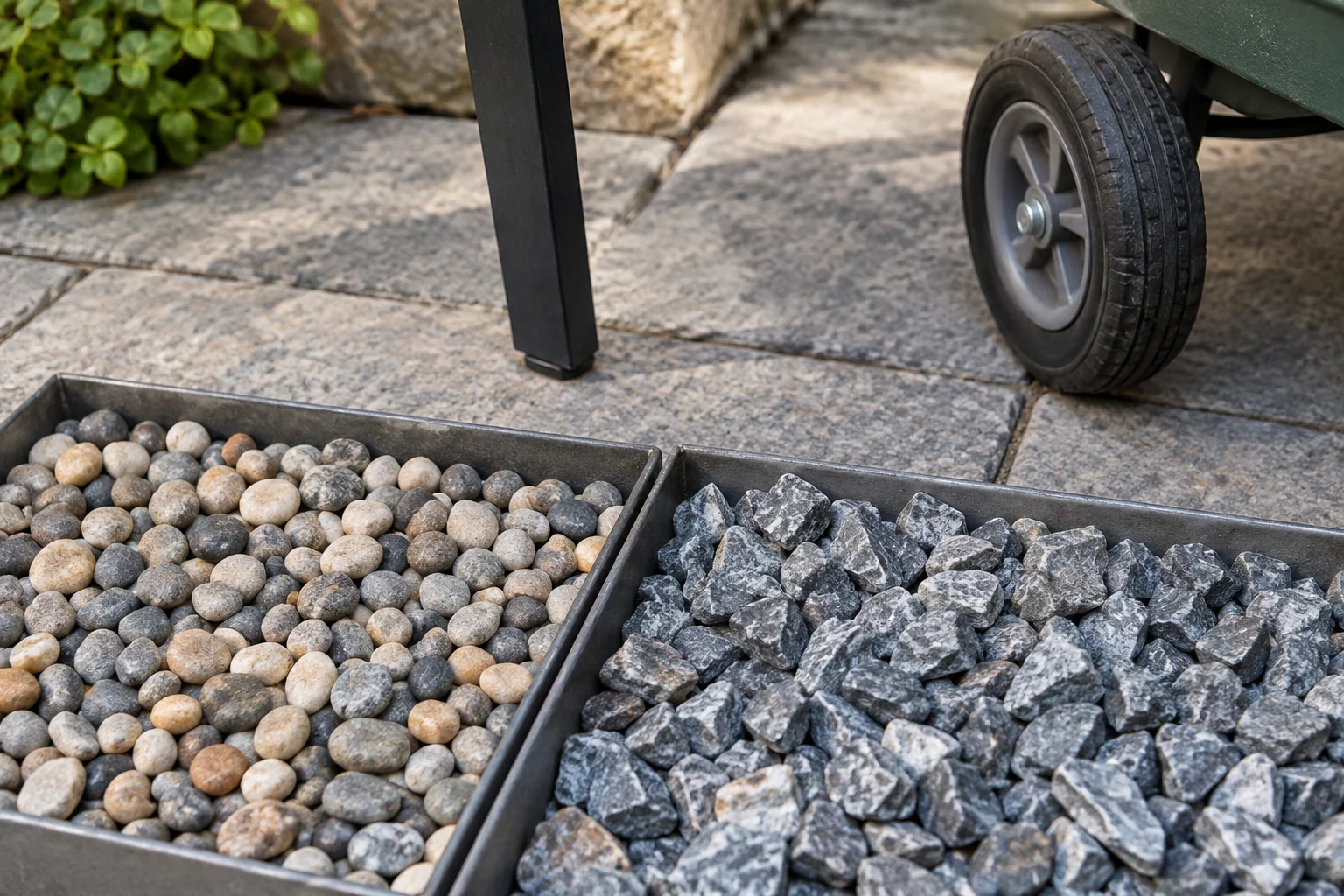
If the area will hold dining furniture, use the intended pieces on a test panel. Narrow chair legs, broad feet and wheels interact differently with loose stones. Test sitting and standing as well as moving the empty chair. Check whether repeated use leaves a hollow or shifts the material toward an edge.
For carts, strollers and mobility devices, include turning at the tightest point. The performance of a straight empty run may not represent a loaded cart entering through a narrow gate. If the proposed surface makes essential tasks difficult, change the design before filling the entire area.
Record the trial's support and layer depth. A handful of pebbles scattered on paving does not represent a full loose surface. Keep the example consistent with the actual proposed installation so the test answers a useful question rather than comparing unrelated conditions.
Think through cleaning around plants
Imagine the bed after leaves, blossoms or soil have accumulated between the stones. Can you lift debris without carrying away the smaller pebbles? Can you reach beneath plants without disturbing roots? Try the intended cleaning tool on a small sample and inspect what is removed with the debris.
Larger individual stones can be picked up and reset, but a broad bed of them may take time to clear by hand. Smaller particles can be easier to rake, yet may mix with soil at the edge. The better choice depends partly on which maintenance task is likely at this location.
Allow access for future planting changes. If you regularly divide, replace or add plants, consider how the stone cover will be moved and kept separate from excavated soil. A visually permanent surface over a frequently changing border can create repeated sorting work.
Do not mistake decorative stone for drainage design
Water visible between stones still needs a route through or away from the lower layers. A decorative dry-creek appearance does not establish the channel's capacity or a suitable outlet. If the feature will actually convey runoff, treat its dimensions, stone selection and discharge route as a separate site-design question.
For manufactured water features, use the equipment instructions. As one specific example, the Aquascape DecoBasin instructions call for 1–2-inch gravel or river stone over its lid and splash skirt. That requirement belongs to that system; it is not a general recommendation for every pond, drain or garden bed.
Check service access, support and compatibility before selecting decorative material around equipment. A product sold for landscaping does not automatically meet every manufacturer's loading or size requirement. Keep the instructions with the order so an attractive substitution does not create a hidden maintenance problem.
Calculate from the selected layer, not the stone name
Once the product and layer are chosen, use the river-rock calculator to estimate volume from the measured area and depth. Keep supplier density and any ordering allowance separate from that geometric volume.
For an illustrative 10-foot by 3-foot strip, a chosen 2-inch layer occupies 10 × 3 × 2 ÷ 12 = 5 cubic feet. A chosen 3-inch layer over that same area occupies 7.5 cubic feet. These are geometric comparison inputs, not installation depths prescribed for either material.
The additional inch increases volume by 50%. If the first option is sold in 0.5-cubic-foot bags, its nominal requirement is ten bags; the second is fifteen bags at the same package volume. Do not assume larger individual stones necessarily mean fewer purchased cubic feet for the intended finished cover.
Check the supplier's coverage information for the actual size range and intended arrangement. A coarse decorative layer may have a different visual coverage requirement from a fine pebble surface. Keep that product-specific guidance separate from the basic area-times-depth calculation and note any stated basis.
Calculate mixed zones without double counting
Suppose a design contains a 6-foot by 4-foot small-pebble zone and a separate 6-foot by 1-foot larger-stone accent strip. At illustrative depths of 2 and 3 inches respectively, the volumes are 24 × 2 ÷ 12 = 4 cubic feet and 6 × 3 ÷ 12 = 1.5 cubic feet.
Keep the two quantities separate because they are different products. The combined volume is 5.5 cubic feet, but one order for that amount of a single material would not complete the design. If the accent strip sits inside a larger measured rectangle, subtract its area from that rectangle before calculating the small-pebble portion.
For a curved accent, measure the real outline or divide it into manageable shapes. Do not multiply its maximum width by its full length and then present the result as exact. Label a deliberately conservative rectangular estimate and compare it with more detailed measurements if the difference affects the order.
Compare purchase and handling costs
Use current quotes for the named size and product, including delivery and minimum quantities. Price per bag is meaningful only when bag contents are comparable. A smaller bag of an expensive accent stone can look inexpensive beside a larger bag of ordinary pebbles until the required volume is calculated.
For example prices of $6 per half-cubic-foot bag and $9 per half-cubic-foot bag, the 5-cubic-foot and 7.5-cubic-foot options above cost $60 and $135 respectively. Those invented prices illustrate the calculation; they do not establish typical market prices or a universal cost relationship between pea gravel and river rock.
Include handling in the plan. Confirm how the material will arrive, where it can be staged and how it will reach the bed. If sold by mass, obtain a product-specific conversion rather than borrowing a universal stone density. Individual particle size alone does not tell you a bulk load's weight.
Check the smallest pieces in a mixed sample
When comparing maintenance methods, include the smaller particles present in the actual batch. A screen or rake that retains the largest river stones may still lose useful smaller pebbles and gradually change the bed's appearance.
Keep the chosen sample and placement record
Use the pebble and river-rock zone comparison to record the actual size, product, purpose, trial and layer. Keep a ruler in the sample photograph, and include the smaller pieces when testing a rake or screen.
Before spreading, match the delivery to that record and keep separately ordered sizes apart. Choose by demonstrated fit for the activity and maintenance task; the sales name alone is not the specification.
Sources and further reading
- Material Guides — Braen Supply — source reviewed 2026-10-07.
- Chamois Beige Pea Gravel material specifications — Southwest Boulder and Stone — source reviewed 2026-10-07.
- DecoBasin Instructions and Maintenance — Aquascape — source reviewed 2026-10-07.