 Rob
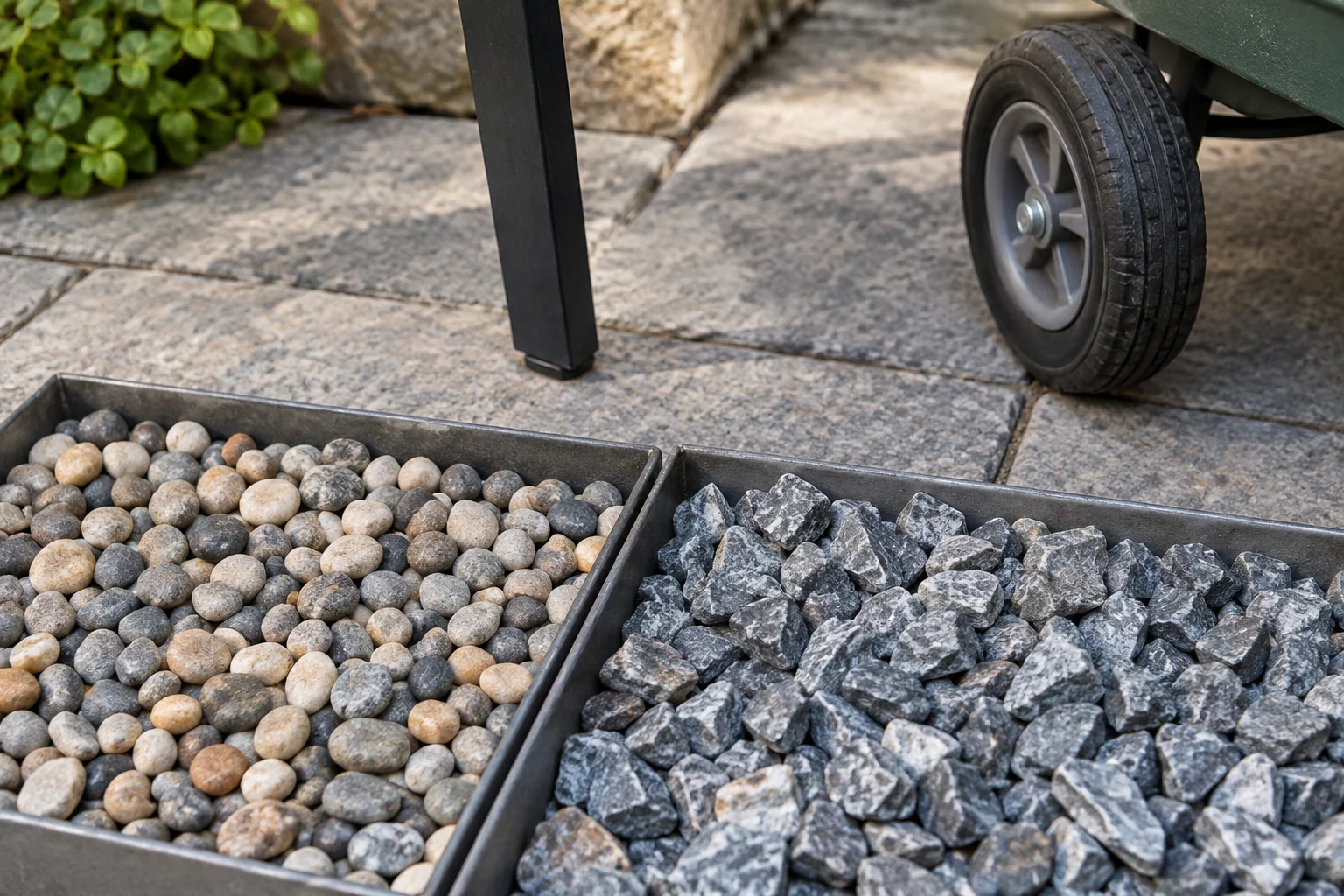
Pea gravel and crushed stone can create very different walking surfaces, but the comparison needs more detail than rounded versus angular. Ask which crushed product is being offered. Clean angular chips and a well-graded pathway blend containing fines are not the same material, even when both are called crushed stone.
| Question | Pea gravel candidate | Crushed-stone candidate |
|---|---|---|
| Particle form | Confirm rounded size range | Confirm angular grading and fines |
| Furniture and wheels | Try the actual use on a sample | Try the actual use on a sample |
| Containment | Specify edges and transitions | Specify edges and transitions |
| Maintenance | One cleanup trial | Same task and conditions |
| Cost | Purchased material + assembly + delivery | Same included scope |
For a path or patio, judge the surface by the people and activities it must support. Walking in garden shoes, rolling a stroller, moving a wheelbarrow and sliding a dining chair place different demands on loose aggregate. Compare actual samples and complete installation details before choosing from a photograph.
Define the two products you are comparing
Pea gravel usually describes small rounded particles. As one supplier example, Southwest Boulder & Stone describes its general pea-gravel category as smooth and rounded, commonly about 1/8–3/8 inch. Confirm the range of the specific local product; that description is not a universal grading specification.
Crushed stone describes material produced by crushing, but it can be screened and blended into many products. A clean decorative chip, a road-base blend and a fine pathway aggregate may all originate from crushed rock. Name the actual size, grading, fines content and intended use before treating one of them as the alternative to pea gravel.
For a fair comparison, collect equivalent information for both candidates. Record the supplier, product code, size description, available grading information, price basis and installation guidance. If one candidate is a complete specified pathway material while the other is simply loose decorative aggregate, acknowledge that difference in the decision.
Shape affects movement, but it is not the whole assembly
The FHWA Gravel Roads Construction and Maintenance Guide explains that fractured particles resist movement under loads better than naturally rounded particles in road surfacing. That principle helps explain the comparison, but a garden patio still needs its own appropriate surface, base, containment and drainage arrangement.
Rounded particles have fewer angular faces to engage with neighboring stones. Angular pieces can interlock, but a loose clean chip layer does not automatically become a smooth, rigid floor. Size distribution, material properties, placement and the support below affect the finished result. Avoid describing all crushed stone as though it behaved like compacted paving.
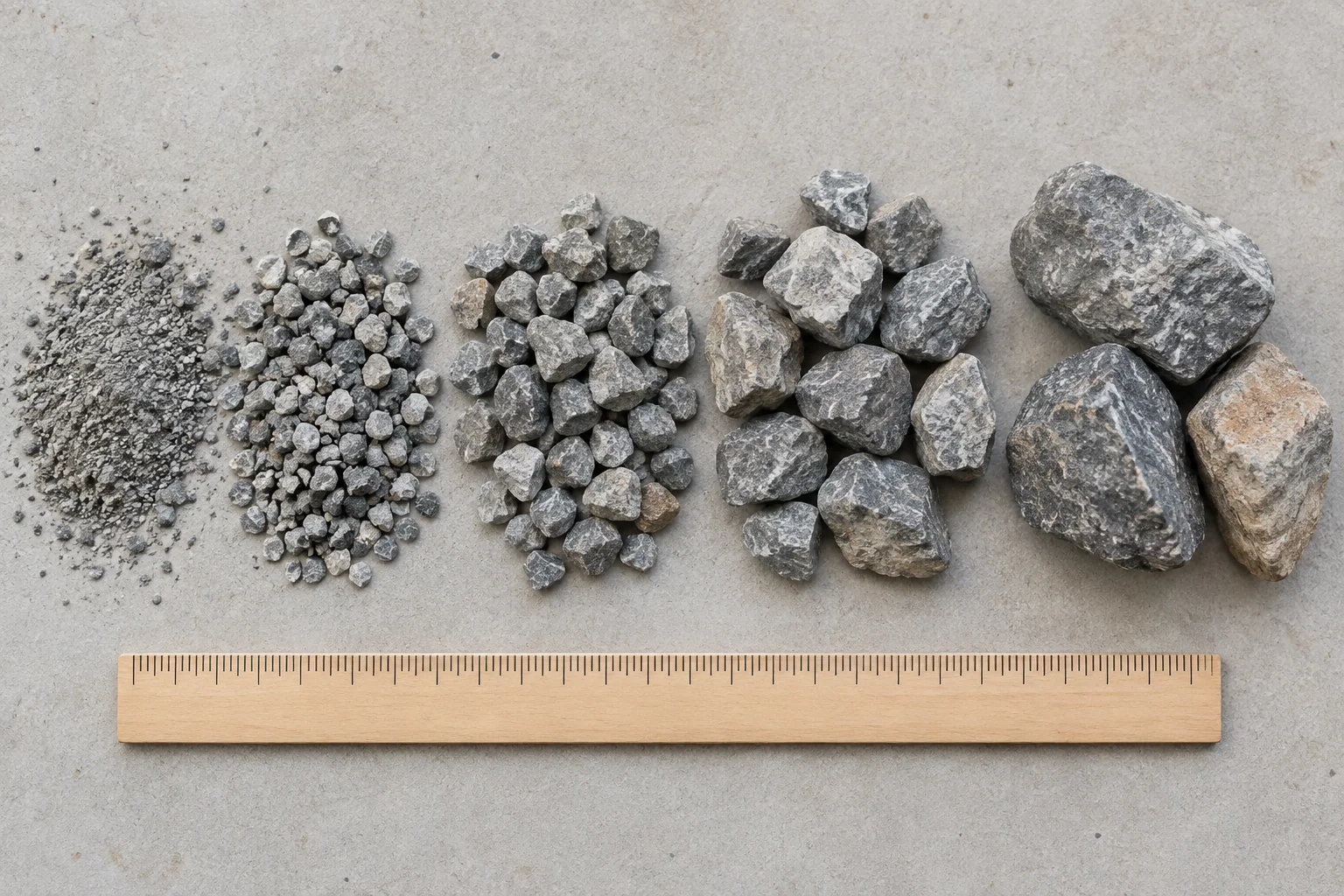
The original close-up illustration shows the shape distinction without promising a measured performance advantage. It deliberately includes a third group with smaller particles between the larger pieces. That group makes grading visible, which is often the missing variable in a two-way product comparison.
Separate settling from a specified compacted surface
Loose pea gravel can rearrange and settle under use, but rolling it does not turn rounded decorative pebbles into a continuous bonded surface. If a firm pathway is the objective, begin with a material and installation designed for that outcome. Do not buy loose aggregate first and assume a hired compactor will supply the missing specification.
Luck Stone distinguishes open-graded aggregate from dense-graded material containing coarse particles and fines for compaction. The distinction matters when interpreting the phrase “packs down.” Ask which product is intended to compact, to what condition, and as part of which installation.
A clean angular aggregate can still be placed and consolidated in a specified layer; the issue is what finished behavior is required. Avoid the opposite oversimplification that any aggregate without fines is incapable of useful compaction. A manufacturer's or designer's instructions are more meaningful than a general claim about one material category.
Compare the finished uses side by side
| Use | Loose pea gravel | Crushed alternative | Useful trial |
|---|---|---|---|
| Occasional garden walking | Assess particle movement and migration | Distinguish clean chips from pathway blend | Walk, turn and stop in normal footwear |
| Dining furniture | Check sinking and sliding of legs | Check firmness and surface texture | Use the intended chair and table |
| Small wheels | Check resistance and rutting | Check the complete constructed surface | Try the actual device and user |
| Leaf-heavy location | Check stone loss during cleanup | Check fines disturbance during cleanup | Test a manageable patch |
The table is a comparison plan rather than a product ranking. A result acceptable for an occasional side path may be frustrating at the main entrance. State the essential activities first so an appealing color or an easy delivery does not outweigh the surface's everyday function.
Include the people who will use the space. A sample judged only by the person building it may miss someone else's mobility, balance or footwear needs. Where formal accessibility requirements apply, a casual trial cannot establish compliance; use an appropriate designed route and verified performance information.
Test furniture before committing to a patio
Use the actual chair, including its foot shape, on a representative trial surface. Sit, stand and move it normally. Watch whether legs dig in, whether the chair tilts and whether repeated use displaces material. A broad lounge-chair foot and a narrow dining-chair leg can behave differently on the same aggregate.
Check the table separately. A table that stands acceptably when empty may become awkward if the surrounding chairs repeatedly disturb its support. Try realistic access around the perimeter, including carrying a tray or moving between closely spaced seats. The available flat usable area matters as much as the overall patio dimensions.
If a separate hard-standing zone is needed for furniture, design its transition intentionally. Do not count its footprint twice when ordering gravel, and do not assume loose aggregate will remain neatly away from the edge without maintenance. A mixed-material layout can work, but it introduces another detail to resolve.
Evaluate wheels and frequent routes
Test a stroller, cart, wheelbarrow or mobility device on the proposed surface if those uses matter. Include turning and stopping, not just a straight push. Small front wheels and loaded garden carts can reveal difficulties that a quick walking test misses.
Keep the trial representative of the intended layer arrangement. A shallow handful of gravel on concrete is not equivalent to a full loose layer over a prepared base. Conversely, an excessively deep sample pile can make any loose aggregate appear worse than the planned installation. Record the trial depth and support.
If the route must provide reliably firm access in varied weather, compare purpose-designed pathway systems or other surfacing options as well. The choice need not remain limited to two loose stone samples. Start with the required performance, then identify materials and assemblies capable of providing it.
Drainage depends on more than visible gaps
Open spaces between stones do not establish where water will go after entering the surface. The lower layers and underlying ground may be slower, and the site may receive runoff from elsewhere. Draw the intended water route before interpreting either product as a drainage solution.
Some fine pathway blends and stabilized products have particular moisture and drainage requirements. Kafka Granite's pathway range separates standard, organically stabilized and wax-coated materials; it identifies the wax-coated option as impermeable. “Crushed pathway material” therefore does not mean one universal permeability.
Check the selected product's current instructions and the site's levels. Keep water away from vulnerable building details and do not redirect runoff casually across property boundaries. Where the project needs a drainage design, the surface aggregate comparison is only one part of that work.
Plan containment and transitions
Place particular attention at doorways, paving edges and lawn boundaries. A loose surface can move into adjacent areas through walking, wheels or maintenance. Consider whether the edge is intended merely to define the outline or to retain the selected layer, and choose details appropriate to that purpose.
Check the transition height with the actual surface assembly. An edge that contains aggregate can still be awkward to cross. A doorway or narrow gate may need a different detail from a decorative border. Draw these locations before calculating the broad open area so they are not left as last-minute improvisations.
If using a cellular confinement product, follow its aggregate, fill and installation requirements. A grid does not make every pea gravel or crushed stone suitable for every application. Treat it as a specified system and include its effect on the visible surface and maintenance in the comparison.
Calculate equal footprints on a documented basis
For an illustrative 12-foot by 10-foot patio, a chosen 2-inch surface layer occupies 12 × 10 × 2 ÷ 12 = 20 cubic feet, or about 0.741 cubic yard. This is a geometric example, not a universal patio depth. The appropriate depth comes from the chosen surface system.
If another specified option needs a 3-inch finished layer, its geometric volume over the same footprint is 30 cubic feet, or about 1.111 cubic yards. Comparing only the price per cubic yard would miss the different quantity. Also separate compacted finished volume from loose purchase volume using documented product guidance.
For example prices of $80 and $65 per cubic yard, the unrounded material-only subtotals would be about $59.26 for 0.741 yard of the first product and $72.22 for 1.111 yards of the second. These invented prices demonstrate why the cheaper unit rate need not produce the cheaper surface layer.
Test the cleanup method on both candidates
Place a small amount of representative leaf litter on each trial panel and try the maintenance method you intend to use. Observe how much aggregate moves with the debris and whether cleanup leaves hollows. Record the result alongside walking and furniture trials. A surface that feels pleasant underfoot can still be an inconvenient choice beneath trees if its routine cleaning is difficult in the available space.
Compare the complete first purchase
Continue the illustrative patio comparison with different delivery increments. Suppose the first supplier sells only whole cubic yards, so the 0.741-yard need requires buying 1 yard at $80. If delivery is $50, the delivered surface-material charge is $130. The second supplier sells quarter-yard increments, so 1.111 yards requires 1.25 yards at $65, or $81.25, plus an example $40 delivery: $121.25 total.
The ranking has changed from the unrounded material-only comparison. That does not prove the second complete patio is cheaper: base materials, containment, installation labor and any product-specific placement requirements still need to be priced. Show those as separate lines rather than concealing them within an unexplained “gravel patio cost.”
Also price the transition to existing paving. If one option requires a changed edge or a different entrance detail, include that work. If both use the same correctly specified base, avoid charging that shared work to only one candidate. A fair comparison describes the same usable area and essential functions for both proposals.
Include maintenance in the choice
Once both products have a specified surface depth, use the pea gravel calculator to estimate the rounded-stone option and the gravel calculator for the alternative. Keep each product’s depth, supplier bag size and any justified loose-volume adjustment separate so the comparison describes the same usable area.
Sources and further reading
- Pea Gravel Landscaping — Southwest Boulder and Stone — source reviewed 2026-10-07.
- Gravel Roads Construction and Maintenance Guide — FHWA — source reviewed 2026-10-07.
- Aggregate Products and Terminology — Luck Stone — source reviewed 2026-10-07.
- Pathway Materials — Kafka Granite — source reviewed 2026-10-07.