 Rob
Rob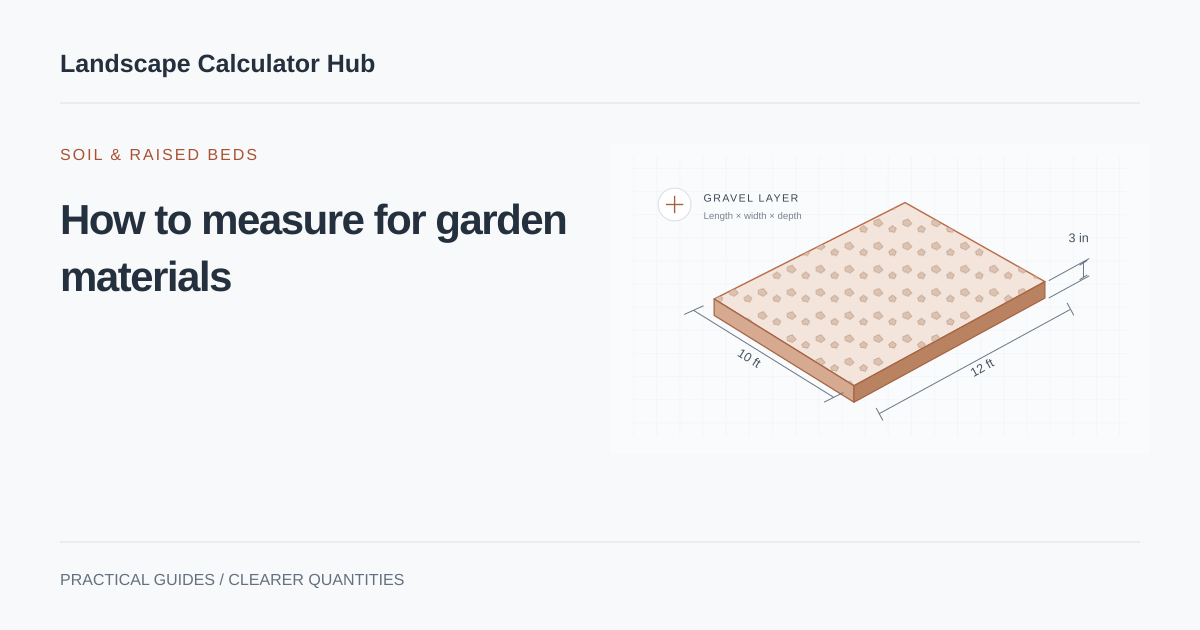
Measure rectangles, circles and irregular gardens, choose the added depth and convert area into a material volume.
Start with the space, then the layer
A footprint gives you area. A layer depth turns that area into volume. Measuring only the garden’s length and width is not enough to calculate the material order. Use a tape measure and record the unit beside every number.
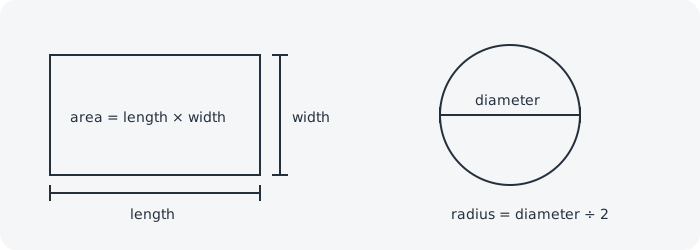
Rectangular and circular areas
Rectangle area = length × width
Circle area = π × radius²
Volume = area × depth
A circular bed with a 4 m diameter has a 2 m radius, so its area is 4π m². At 10 cm deep the volume is 0.4π m³, about 1.257 m³. Entering 4 m as the radius would make the area four times too large.
Keep units consistent
For a 10 ft × 12 ft rectangle at 3 in deep, convert 3 in to 0.25 ft first. The volume is 10 × 12 × 0.25 = 30 ft³. Divide by 27 for cubic yards, giving about 1.111 yd³. Our tools convert length and depth units separately before multiplying.
Irregular gardens and changes in depth
Split an irregular area into sections that can reasonably be represented by rectangles or circles. Use non-overlapping sections, calculate each and add them to the list. For genuinely uneven depth, calculate sections separately rather than pretending one thickness is exact. The tool does not model slopes or subtract curved cut-outs automatically.
Raised beds and existing material
Use inside measurements for an enclosed bed. For a top-up, enter the remaining depth to fill, not the full height. Where a tree trunk, solid insert or existing pile occupies space, measure the remaining fill space. Avoid silently counting occupied volume.
Keep a useful measurement note
- Write the length, width or circle diameter and the unit.
- Write the added layer depth and whether it is in-place or loose.
- Record which sections overlap, and remove any duplicate area.
- Keep allowances separate so you can explain them to the supplier.
For exact unit definitions see NIST’s international-foot conversion table. We use the international foot, not the legacy US survey foot.