 Rob
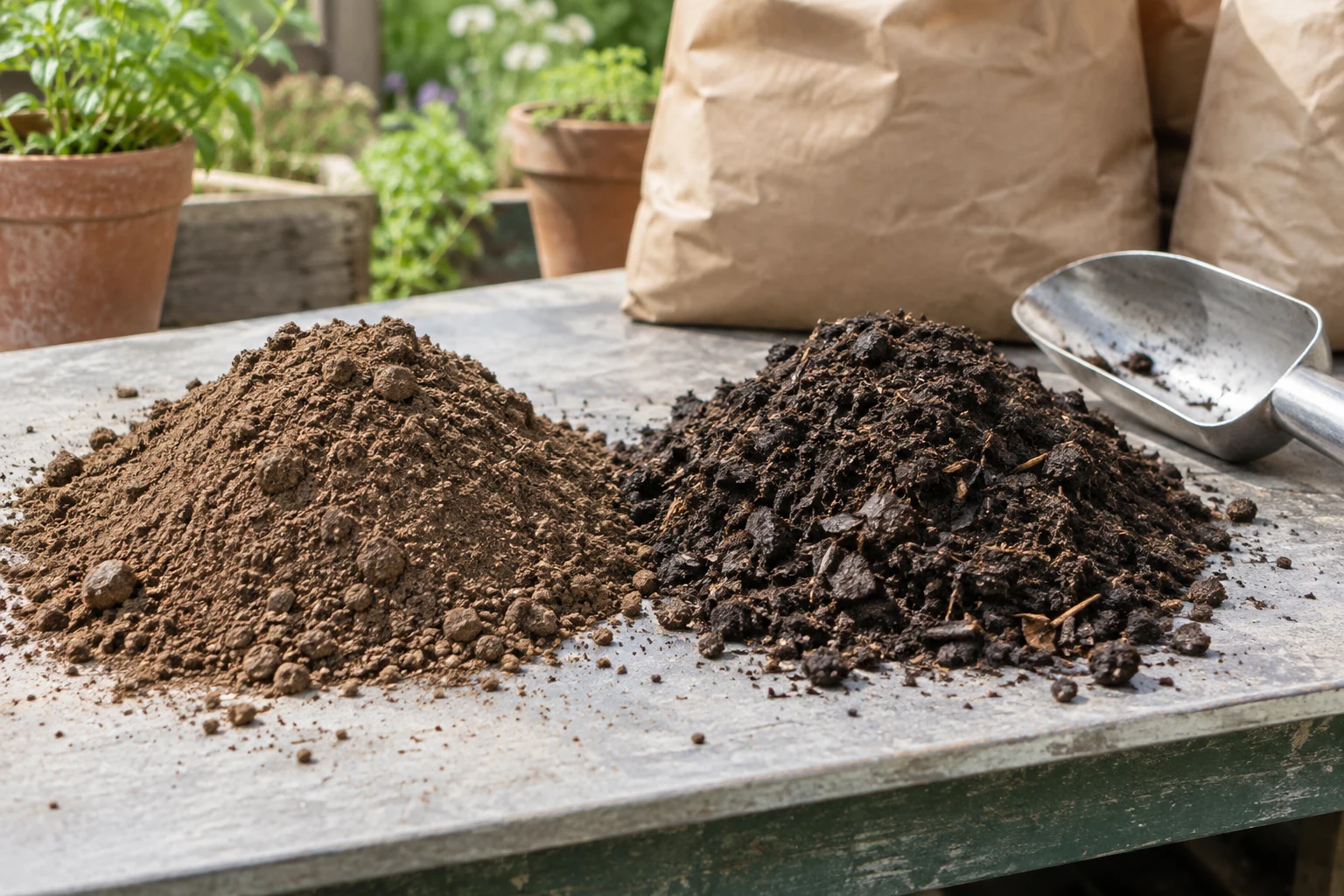
Topsoil and compost usually solve different problems. Suitable topsoil supplies a mineral-soil base where soil volume is needed. Finished compost is an organic amendment whose amount should follow the existing soil, the crop and the product analysis. A bed that needs filling may use both, but replacing one with the other by volume does not create an equivalent growing medium.
| Job | Material role | Evidence before purchase |
|---|---|---|
| Create a growing-soil volume | Suitable topsoil or specified blend | Quality and intended-use specification |
| Improve existing soil | Appropriate compost amendment | Soil and product analysis |
| Fill and amend | Separately specified components | Account for compost already in any preblend |
Before buying, define whether the job is to fill a new space, improve existing soil or maintain an established planting. Then measure the quantity for that job. The calculation can be exact while the material choice is wrong, so settle the purpose first.
Once you have chosen an amendment depth, use the compost calculator to estimate the volume for your measured area.
Start with the problem in the bed
If both products are sold for filling a new bed, use the topsoil and garden-soil comparison to check intended use and what the product label actually specifies.
A new ground-connected raised bed has an empty volume. An existing vegetable plot may already be at the intended level but need a soil amendment. A low area beside a building may involve drainage and finished grades. These are three different projects even if each shopping list initially says “soil.”
Sketch the present and proposed levels, identify the plants and note what is underneath. Do not assume an elevated planter with a solid base behaves like an open-bottom bed connected to the ground. The growing medium, drainage and support requirements can differ.
If the issue is poor plant growth rather than a missing volume, begin with observations and an appropriate soil test. Buying more dark material is not a diagnosis. Existing nutrients, pH, drainage and compaction all affect the next step, and some problems are not solved by adding material at all.
What topsoil contributes
Utah State University Extension distinguishes topsoil from subsoil and evaluates quality using physical and chemical properties. The useful buying lesson is that the name and dark appearance do not establish suitability. Ask about the actual material, its origin and relevant test information.
For planning, treat topsoil as a candidate mineral-soil component, not as a promise that every load has the same texture or fertility. A supplier's amended blend may already contain compost. Record that before deciding how much extra organic material to add.
Compare the imported material with what is already present. If the proposed load offers no clear improvement and no additional volume is needed, importing it may create handling work without resolving the original problem. The purchase should have a defined purpose beyond making the surface look darker.
What compost contributes, and why more is not always better
Oregon State University's compost guidance describes products made from varied feedstocks and recommends checking analyses and production information. Two products called compost may differ in maturity, particle form and chemistry. Ask whether the product suits the proposed use rather than assuming compost is a uniform ingredient.
University of Minnesota Extension documents problems from excessive compost applications, including nutrient and soluble-salt accumulation. Its advice starts with testing where overapplication is suspected. This is a reason to use an evidence-based amount, not a reason to avoid all compost.
A nutrient-rich amendment is not automatically an appropriate bulk filler. If the bed needs a large volume, the amount of compost should be considered as part of the growing-medium plan. Do not select the percentage solely because compost happens to be the cheapest available load.
| Job | Question about topsoil | Question about compost |
|---|---|---|
| Fill a ground-connected bed | Is this a suitable tested mineral-soil component? | What proportion fits the crop and materials? |
| Amend an existing bed | Is added soil volume actually needed? | What application follows the soil assessment? |
| Maintain an established bed | Would extra soil bury plants or alter levels? | Does testing support another application? |
| Resolve a wet or damaged site | What is causing the site problem? | Would amendment address that cause? |
A blend recipe needs a stated context
Minnesota's raised-bed guidance describes mineral topsoil and plant-based compost mixtures for ground-connected garden beds. That is a useful context for discussing a blend, but it does not turn every ratio into a universal recipe for pots, roof gardens or all existing soils.
Before using a proposed ratio, confirm whether it is by volume or mass and whether the source means separately measured ingredients or the final mixed product. For a home buying estimate, separately measured loose volumes are often the clearest basis. Their sum is a planning quantity; particles can rearrange when combined.
Ask whether the topsoil already contains a measured compost addition. If it does, adding another full recipe's compost amount can double-count that component. A premixed product and two raw components require different shopping calculations even when the intended final use is similar.
Worked example: two components for an empty bed
Inputs and calculation
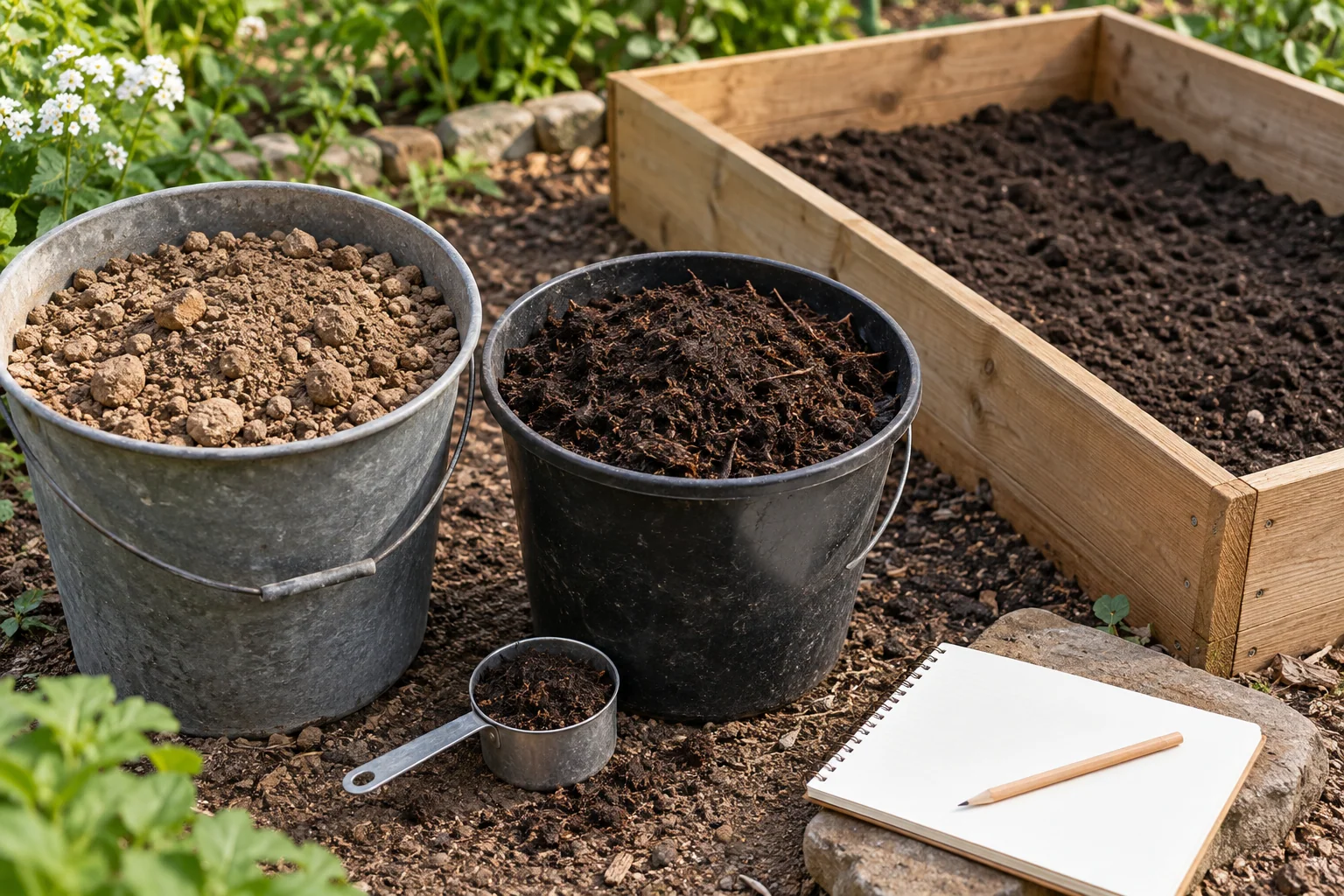
Suppose a suitable plan for a particular open-bottom bed specifies a loose-volume blend of two parts topsoil to one part plant-based compost. The bed's internal dimensions are 8 feet by 4 feet, with a chosen 9-inch fill depth. Its geometric space is 8 × 4 × 9 ÷ 12 = 24 cubic feet.
Using the agreed two-to-one split as a preliminary ingredient estimate gives 16 cubic feet of topsoil and 8 cubic feet of compost. In cubic yards, those are approximately 0.5926 and 0.2963 respectively. The ratio here is conditional on the plan and materials; the calculation does not select it for other beds.
Interpret the purchase
If topsoil is sold in 1-cubic-foot bags and compost in 2-cubic-foot bags, the preliminary order is sixteen topsoil bags and four compost bags. If both are bought in bulk, ask about minimum quantities and increments separately. Do not combine the two components into one unspecified 0.8889-cubic-yard load.
After mixing and placement, measure the actual level. The combined ingredient volumes do not guarantee an identical settled volume, and no universal settlement percentage is assumed here. Obtain a supplier's compatible yield information if available, or plan a measured follow-up rather than an invented compaction factor.
Worked example: amendment without bulk filling
Inputs and calculation
Now consider an existing 12-foot by 5-foot bed. Suppose its assessment supports applying a half-inch compost layer as part of a specified amendment plan. The area is 60 square feet and the compost volume is 60 × 0.5 ÷ 12 = 2.5 cubic feet.
Two 2-cubic-foot bags provide 4 cubic feet, leaving 1.5 cubic feet beyond the calculated application. That remainder is not a reason to increase the application rate. Identify another suitable use or retain it according to the product's storage directions.
Interpret the purchase
The amount calculated is the applied compost volume. It does not imply the bed will permanently rise by half an inch after incorporation, settling and later decomposition. Keep the application measurement separate from predictions about final soil level.
If a neighboring bed has different test results, do not automatically apply the same layer there to use the spare bag. Separate soil conditions deserve separate decisions even when the beds are close together and grow similar crops.
Compare quotes on the full mixture
For the 24-cubic-foot example, imagine hypothetical prices of $3 per topsoil bag and $7 per compost bag in the sizes above. The component purchase costs 16 × $3 plus 4 × $7 = $76 before delivery or tax. These are invented comparison prices, not current market quotations.
A premixed quote should specify its ingredients, suitability and supplied volume before its price is compared with $76. A cheaper load of unknown composition is not an equivalent offer. Conversely, a suitable premixed product may reduce mixing work that the component price excludes.
Add delivery, access and handling to the comparison. Two bulk components may require separate piles or deliveries, while bags can be staged closer to the bed. Keep the cost of the chosen plan visible without turning convenience into a claim of better horticultural performance.
Inspect the soil interface as part of preparation
Oregon State University's soil improvement guide cautions that adding topsoil over compacted subsoil can leave underlying limitations unresolved. A new upper layer does not automatically create a suitable root environment through the whole profile.
Record what is beneath the proposed fill: existing soil, a compacted construction surface, paving or another layer. Follow a preparation plan suited to that condition. Do not convert general advice about a ground-connected bed into instructions for a raised structure with an enclosed base.
Existing tree roots and plant crowns also limit where levels can be changed. If the proposed fill overlaps established planting, resolve the placement before delivery. A full load on the driveway creates pressure to spread it somewhere, which is a poor moment to discover that the intended area cannot accept it.
Read the analysis with its units
A soil report's organic-matter percentage is not automatically a compost volume percentage. Keep the method and units attached to the result. Do not read “5% organic matter” as an instruction to mix five buckets of compost into ninety-five buckets of soil.
Likewise, a compost nutrient analysis describes the product under a stated method. It does not directly specify a fertilizer program for the finished bed without considering application amount and crop needs. Ask the laboratory or extension adviser to interpret the relevant report rather than translating every number into a homemade ratio.
Save sample dates and identify which pile or product they represent. A report for last year's stockpile may not describe a changed source. If a supplier blends materials, ask whether the analysis covers the complete current blend or just one component.
Organize the delivery and mixing work
- Keep component piles distinct until their quantities have been recorded. Use the same measuring container for each part if following a volume ratio, and fill it consistently without deliberate compression. A heaped shovel and a level bucket are not interchangeable measures.
- For several beds, make a material allocation before starting. Mark which bed receives which assessed blend or amendment. This prevents the first bed from consuming a large share of one component and leaving the remaining beds with a different unintended ratio.
- Retain the labels, supplier information and final quantities. On the topsoil and compost planning sheet, note both the initial plan and the actual placed amount. Future maintenance is easier when the original mix is documented rather than remembered as “mostly soil with some compost.”
Check the mixed batch before scaling up
Prepare one small batch using the intended measuring container and sequence, then record how many batches the order can supply. This checks the workflow rather than proving horticultural performance. If two people will mix the material, have both reproduce the same measured batch. Differences in how a container is filled can otherwise change the practical recipe even though both workers believe they are following the same ratio.
Plan later additions from evidence
Keep one shared dated record of additions, including material and actual volume, so several gardeners do not unknowingly repeat an application. Note crop and growing conditions without assuming the latest amendment caused every change.
Next season, distinguish a measured level deficit from a soil-test recommendation. Retaining a suitable blend does not mean repeating its construction recipe or adding pure compost annually. Review the current soil, product and growing conditions before choosing a follow-up material.
Sources and further reading
- Topsoil Quality Guidelines for Landscaping — Utah State University — source reviewed 2026-10-07.
- How to use compost in gardens and landscapes — Oregon State University — source reviewed 2026-10-07.
- How to correct problems caused by using too much compost and manure — UMN Extension — source reviewed 2026-10-07.
- Raised bed gardens — UMN Extension — source reviewed 2026-10-07.
- Improving garden soils with organic matter — Oregon State University — source reviewed 2026-10-07.