 Rob
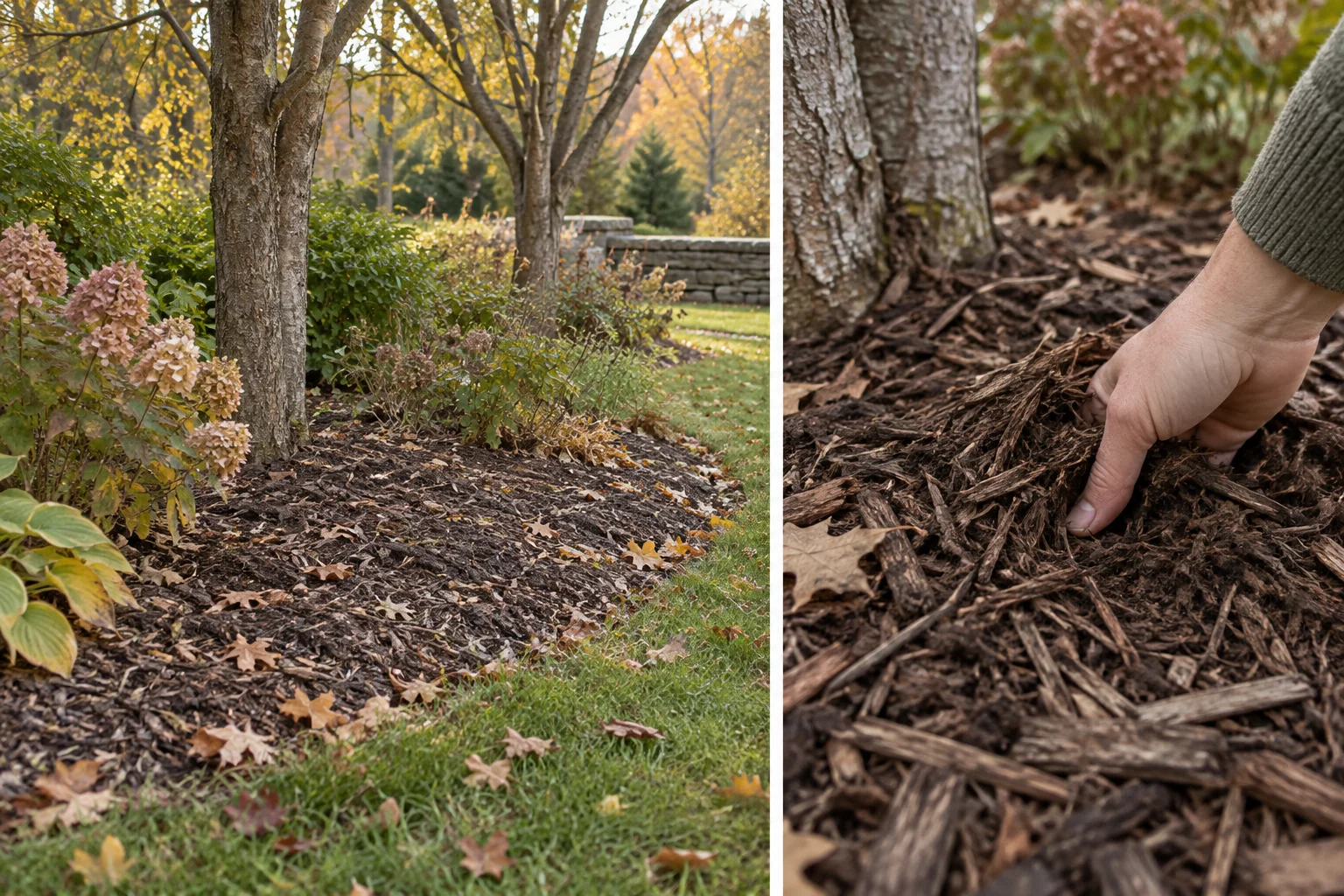
Mulch needs topping up when its remaining useful layer is too thin for the planting and material, not simply when its color fades or a year has passed. Inspect depth, distribution and water entry before buying. A bed can look tired while still containing plenty of mulch, and a fresh-looking bed can be thin where runoff or a leaf blower has moved the material.
| Material | Oregon State woody-ornamental guidance | What to inspect |
|---|---|---|
| Bark | 2–4 years | Depth, distribution and condition before ordering |
| Wood chips | 1–2 years | Particle size, settling and usable existing cover |
| Either material | These are inspection guides, not expiry dates | Fading alone does not establish a volume deficit |
A useful maintenance plan separates three things: color change, physical settling and biological decomposition. They can happen together, but they do not mean the same thing. Measure the deficit you actually find and enter that additional depth in the mulch calculator.
A lifespan is an inspection interval, not an expiry date
Oregon State University Extension gives typical reapplication intervals of 2–4 years for bark and 1–2 years for wood chips in its woody-ornamental guidance. It also explains that particle size and settling affect performance. Those ranges are useful context for checking a bed, not guarantees that your particular product will fail or need complete replacement at that age.
To make a claim such as “lasts three years” useful, ask what survives for three years. It could refer to visible pieces, acceptable color, weed suppression or the manufacturer's warranty against fading. A few recognizable chips do not prove adequate coverage, and pale material does not prove that its volume has disappeared.
Build an inspection into garden work you already do: the first substantial seasonal tidy, a check after heavy runoff, or preparation for a new planting. Do not turn that inspection into an automatic order. The outcome might be no purchase, redistribution, a small localized top-up or a wider addition.
What you see, and what it means for the order
| Observation | What to inspect next | Quantity consequence |
|---|---|---|
| Color is faded, but depth remains even | Compare appearance with the need for cover | No automatic full-layer order |
| Whole pieces remain, but the layer is thinner | Measure several sections and check for relocation | Calculate only the measured deficit |
| Bare areas beside deep ridges | Look for raking, wind or water movement | Redistribute appropriate material before buying |
| Fine, soil-like surface with many seedlings | Check actual mulch thickness and identify weeds | Plan weed removal and any justified top-up separately |
| Surface sheds water | Examine matting and soil beneath the cover | Do not simply cover the problem with more mulch |
The table deliberately avoids assigning a replacement year to each symptom. The job is to identify what has changed. An exposed corner that lost chips in a storm needs a different response from a sheltered bed in which small particles have gradually become less distinct.
Compare materials without promising exact years
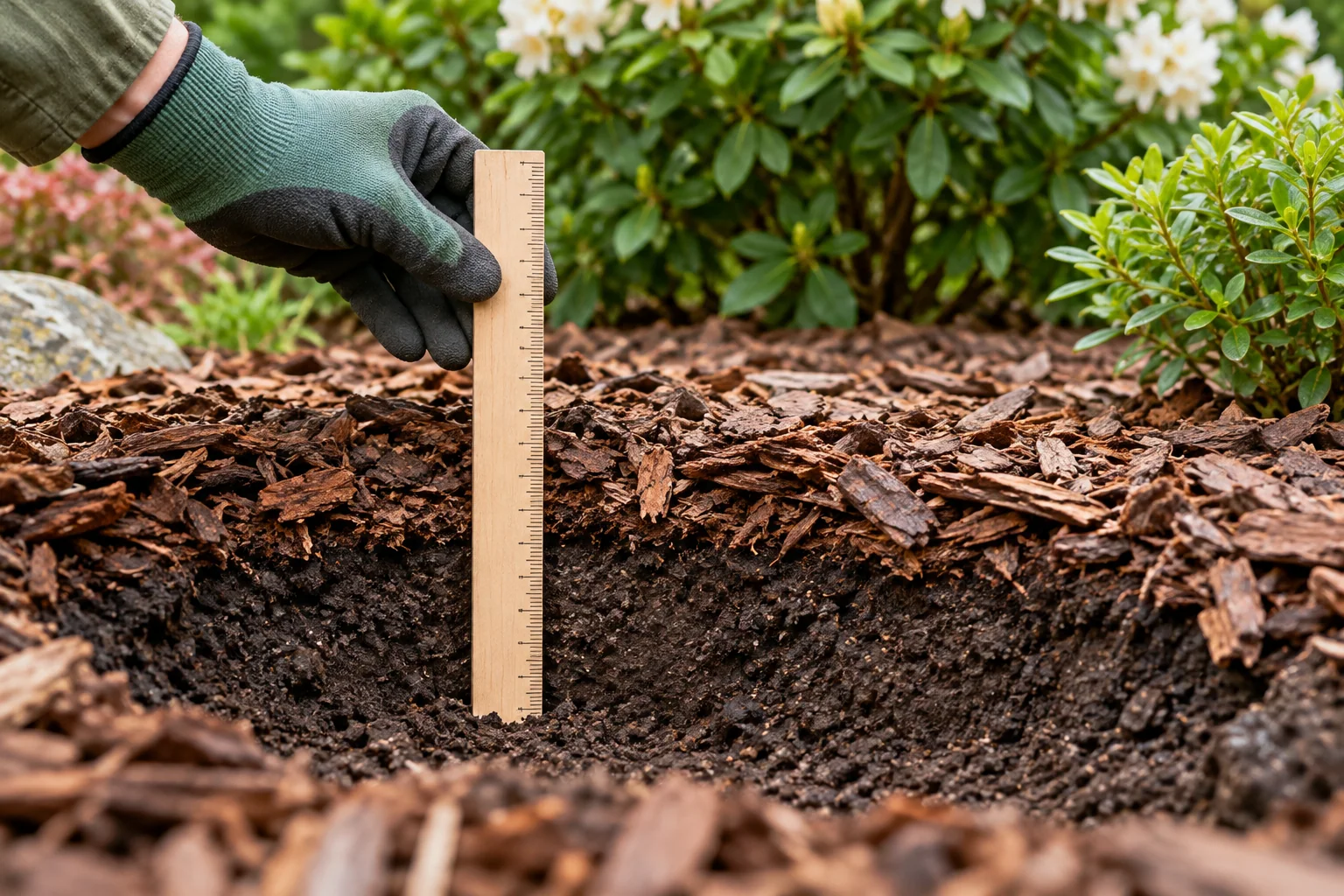
Large, recognizable pieces are easier to assess visually than a fine, dark layer that merges with organic material at the soil surface. When reviewing a product, describe both the material and its texture: “large bark nuggets” tells you more than “brown mulch.” Record the original appearance with a simple photograph and a ruler in the frame.
For bark versus chips, compare similar particle sizes where possible. Otherwise, you may attribute a difference to the tree species when you are really comparing a coarse product with a shredded one. The useful comparison is between the actual options delivered to your garden, including any leaf fragments or fines.
Compost and shredded leaves invite a different expectation from decorative bark. They are often selected partly for their contribution to the soil rather than for retaining a uniform, chunky surface. University of Minnesota Extension distinguishes organic mulches that break down and add organic matter from inorganic covers that do not. Visible change in an organic layer can therefore be part of its function.
Keep the comparison honest by recording maintenance as well as purchase date. One bed may have been raked vigorously, replanted twice and crossed by a hose while another remained untouched. Their different appearance does not constitute a controlled trial of the two mulch brands.
Make a repeatable five-point inspection
- Choose five reference positions you can find again: beside a named shrub, opposite a path joint, near the middle and at two contrasting edges. At each position, open a small window down to soil and measure the recognizable layer. Write the individual depths rather than only a mean. The spread of readings often matters more than the average.
- Next, note distribution. Mark any bare patch, ridge or heap, and check whether the “lost” volume is actually elsewhere in the bed. Record the chosen target for that area so the inspection has a purpose. A reading of two inches is only a deficit if a suitable target is greater than two inches.
- Third, examine the interface during a watering check. Lift a small part of the cover after normal irrigation or rainfall and see whether the soil underneath was wetted. Do not infer soil moisture from the visible color of the surface. An ornamental layer still needs to work with your watering method.
- Fourth, look at plant clearances and any material piled by recent garden work. Finally, identify the reason for weeds before assuming the entire mulch has failed. Weeds can arrive in debris above a cover or regrow through it; a thicker purchase may not solve the particular weed problem.
Worked example: a small top-up beats a full replacement
Inputs and calculation
A 24-foot by 6-foot bed contains 144 square feet. Its owner has selected a suitable total layer of 3 inches for the actual product and planting. Measured usable cover averages 2 inches across reasonably uniform sections. The additional depth is therefore 1 inch, giving 144 × 1 ÷ 12 = 12 cubic feet.
That is approximately 0.4444 cubic yard or six bags labelled 2 cubic feet. A complete new 3-inch layer would require 36 cubic feet, or eighteen bags. If the old layer stayed in place, adding that full order would create a total near 5 inches. The question “how much lasted?” is therefore directly connected to avoiding over-ordering.
Interpret the purchase
If the readings were very uneven, do not use the simple average as a spreading instruction. Split the bed into zones. Eight cubic feet might belong in the windward section and four in the remainder. The total shopping quantity is useful, but the distribution plan determines whether that quantity solves the observed problem.
Worked example: track a metric bed over time
Keep an eye on changing planted area as well as changing mulch depth. A bed that previously had large open gaps may now have plant crowns or spreading groundcover occupying them. Redraw those exclusions before repeating last year's order. A record of the old bed area is useful evidence of what you bought then, but it is not proof that the same area still needs a new layer now.
For a replacement plant, check that local patch separately. Its soil level, remaining cover and clearance may differ from the surrounding established planting even when the rest of the bed requires no addition.
Consider a 10-square-meter bed with a chosen 60-millimeter total layer. At the next inspection, one 4-square-meter section has 40 millimeters remaining and another 6-square-meter section has 50 millimeters. The deficits are 20 and 10 millimeters respectively. Convert these to meters before calculating volume.
The first section needs 4 × 0.020 = 0.08 cubic meter, or 80 liters. The second needs 6 × 0.010 = 0.06 cubic meter, or 60 liters. Together they need 140 liters. Three 50-liter bags supply 150 liters, leaving 10 liters beyond the measured deficit before any separately chosen allowance.
Write the new application date and quantities beside the previous readings. Over successive checks, this becomes a useful record for your own bed. It is better evidence for its next order than a fixed nationwide replacement calendar, although changed weather, planting or maintenance can still alter the next result.
Keep the inspection conditions comparable
Record whether the mulch was dry, recently watered or disturbed when you assessed it. A wet photograph may make faded material appear darker, while a freshly raked patch may look fuller. Comparing like conditions helps distinguish an appearance change from a genuine reduction in useful cover and avoids unnecessary replacement.
Refreshing appearance without concealing a problem
The repeatable mulch inspection record includes spaces for five locations and the action taken at each one. Use stable landmarks rather than temporary stakes if you want to compare next season. Note whether the surface was wet or dry when photographed, because appearance alone can otherwise suggest a larger change than occurred.
If you change products, start a new entry rather than treating the new layer as another observation of the old one. Record any mixture that remains underneath. This keeps a useful household record honest: you can still track the bed's maintenance needs without claiming that the resulting lifespan belongs entirely to either product.
If the only complaint is color, first assess the existing layer without its cosmetic bias. Light redistribution may expose a different-looking surface, but avoid churning soil and mulch together. If you add a cosmetic skim, it still counts toward total depth. There is no separate invisible allowance for “freshening.”
Where material is matted, contaminated or entangled with roots, pause the routine top-up and work out the appropriate treatment. Replacing every bed on a calendar is wasteful, but keeping unsuitable material merely because it is old is not a rule either. The observation should lead the decision.
A practical record needs only the product description, date, five depth readings, any shifted material and the quantity actually added. End each inspection with a specific action: leave, redistribute, investigate or add a measured amount. That gives mulch a service-based maintenance plan instead of an arbitrary birthday at which it must be replaced.
Sources and further reading
- Mulching woody ornamentals with organic materials — Oregon State University Extension — source reviewed 2026-10-07.
- Mulching for soil and garden health — University of Minnesota Extension — source reviewed 2026-10-07.